Read the favorable reviews of the following films and you will
get a sense of how thoroughly the rock-doc, music biopic genre has been
reinvigorated:
Montage of Heck, Amy, What Happened Miss Simone?, and the Brian Wilson biopic
Love & Mercy. All these films share tragic musical figures at the core. Tragic musical figures that made iconic and
important music.
But what does the rock doc look like when the figure at the center is
neither a tormented artist nor an iconoclast? What if the artist at
question is a pop star that people don’t even take seriously?
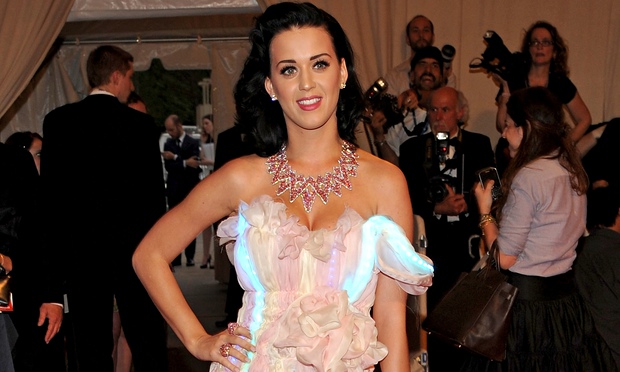
Katy Perry is a bombshell popstar: her candy-colored hair and
technologically-enhanced breasts are an almost comic hyperbole of pop
iconography. Released in 3D on the Fourth of July weekend of 2012,
Katy Perry: Part of Me melded
concert footage, behind-the-scenes footage, home movies, and
interviews. Using the same narrative formula of the films mentioned
above, the documentary frames the story of her rise to pop stardom
against the backdrop of her 2011 Part of Me World Tour and her
tumultuous personal life (that is, her divorce from comedian Russell
Brand). The film fails to deliver a teenage dream or flesh out the
reality of being a solitary pop star. However, in its failure,
Part of Me also highlights how successful rock docs necessarily traffic in
tragedy—not just sadness or misfortune—for entertainment value and to validate their subjects as “true” artists.

Following the massively successful 2011 release of Justin Bieber’s concert movie
Never Say Never,
Perry’s film (produced by the team behind the Bieber doc) provided what
Bieber was not able to provide as a male tween heartthrob: drama of the
reality-television sort. Though dazzling concert footage is the visual
centerpiece of the film, Perry’s private life provides the emotional
core. Russell Brand looms large throughout the film as Perry is shown
struggling with the emotional burden of a marriage that’s falling apart.
Perry is seen checking her text messages and looking visibly upset;
tense phone calls are followed by members of her entourage looking at
her with concern in their eyes. The film slowly builds the tension
toward the dissolution of their relationship. The trailer for the movie
promises an inside look into Perry’s life, teasing their divorce as a
crucial plot point. The film more than delivers this moment, but its
intended effect is uncertain.
In the film’s climax, Perry breaks down moments before taking the
stage in São Paulo, Brazil, the day the media broke the news of her
divorce. She sobs deeply and gasps for breath while her dancers coo,
“You got this.” There is a visually-affecting contrast between Perry’s
audible pain, the chants of thousands of fans screaming her name, and a
crew that is more concerned with the logistics of a possible cancelled
show than with Perry’s emotional well-being. Though the filmmakers
clearly expect the audience to support Perry when she finally plasters a
smile on her face and rises to the stage still choking back tears,
those familiar with the rock documentary genre have a palpable sense of
this moment as one in a series of moments that could build to eat up
even the most resilient stars. As Perry rises to the stage by herself,
the film unwittingly captures how Perry’s fame isolates her, even from
those supposedly closest to her. Her makeup artists, assistants, and
Perry’s own sister confess for months they didn’t know exactly why Perry
was upset. The film clearly shows that they, like the media, gossiped
and whispered about her. At one point, Perry says through tears, “I can
hear you guys talking.” One of her assistants replies, “We know,” and
they continue to whisper concerns with Perry a few steps away.

But the stakes in
Katy Perry: Part of Me aren’t nearly as high as they are in the Kurt Cobain documentary
Montage of Heck or in
Amy,
a documentary about Amy Winehouse. Both of those films are haunted by
the specter of death because the audience is familiar with how their
tragic stories end.
The filmmakers have a more difficult task in
crafting a surprising and refreshing take on the lives of Cobain and
Winehouse when their stories are so well-known already. Though both
films garnered praise from critics for their ability to make their
rather tired subjects new again, both films still rely on a traditional
narrative of artistic genius cut short by tragedy. Both films are driven
by the knowledge that these troubled musicians are headed to an
untimely, and deeply affecting, end.
Montage of Heck is singularly focused on Cobain and his
tragedy rather than placing Cobain in a historical context of the
evolving punk and grunge scene in 1990s Seattle. The movie’s substance
relies on its psychological analysis of Cobain. Though throwaway
references to George Bush Sr. and Bill Clinton superficially attempt to
connect Cobain to political turmoil outside his inner turmoil,
ultimately the film posits Cobain’s musical genius as arising from his
own uniquely felt “alienation” from society that was, according to the
film, only coincidentally connected to happenings in the outside world.
The filmmakers of
Montage of Heck suggest Cobain’s pain came from the disjuncture between what was and how he thought things
should be.
According to the film, this manifested in artwork, poetry, and lyrics
that expressed a discontentment with “authority figures,” though there
are hints that Cobain was also motivated by a vehement hatred of sexist,
classist, and racist hierarchies.
Unlike with Cobain, Amy Winehouse’s music was less about representing
a generation of disaffected youth and more about her unique sound and
authentic lyrics. In that way, Amy Winehouse was, as the documentary
attempts to prove, outside time. Winehouse was a refreshing turn away
from the mechanical and fabricated sounds of singers churned out by the
British pop music machine at the time and back toward the old jazz
greats. In
Amy, Winehouse’s inner life is less parsed
out—possibly because her confessional lyrics need far less
interpretation than Cobain’s series of abstract, visceral phrases. But
Winehouse is also characterized as a more reactive figure: she is
depicted as a victim of other people who abandon her and dismiss her
emotions.
All three films revolve around emotions—love and romance—in similar
ways. For Cobain and Winehouse, their all-consuming romantic attachments
to self-destructive people are framed as the impetus for their
increasing addiction and isolation. By framing them as hopeless
romantics, both documentaries reify the common preconception of artists
as highly emotionally sensitive people. Their artistic talent is
confirmed by their inability to separate love from their work.

Cobain and Courtney Love’s love story was at the center of the Cobain
myth even before his untimely death. The documentary attempts to
demystify their love by juxtaposing criticism of their relationship from
friends, family, and fans with home videos that range from charming to
disturbing. Courtney Love’s own acknowledgement of their family unit as
both incredibly traditional and totally “fucked up” encapsulates their
relationship. Their torrid love affair is both alluring and utterly
irrational.
Amy proposes that for Winehouse, her staunch creative
independence was countered by her over-reliance on the approval from the
men in her life, namely her father and her husband. The film shows how
Winehouse was most creatively productive during times of heartbreak,
taking material straight from her life and translating that into her
most powerful song lyrics. Though
Amy presents us with the
point of view of Blake Fielder-Civil, Winehouse’s husband, it is also
careful to position him as an unreliable narrator. Unlike
Montage of Heck,
Amy is
far more critical of her romantic relationship. This may be in large
part due to Winehouse’s own character rendering. She is depicted both as
an artist and as a
performer, a term synonymous with pop
stardom, which relies less on artistic talent than on charisma.
Winehouse was a romantic and sensitive performer, who, at first,
prioritized her career above all else. However, as the film describes
it, she became more isolated as demands on her artistic production
increased. Her isolation made her more prone to Fielder-Civil’s
influence.
Both documentaries, careful of romanticizing drug addiction, argue
that it wasn’t just love and approval that these musicians were seeking.
They do this by reciting that addiction is a disease and by recounting
various pleas of family members for rehab and intervention. However,
both Winehouse and Cobain are described as doomed long before they have
their first taste of drugs. As children they were “special” or
“different” or “wise beyond their years.” From the outset they were
doomed because they were
artists.
It is Perry’s refusal to be consumed by love that ruins her marriage.
Perry herself frames the divorce as a choice between marriage and her
career, opting out of motherhood and “slowing down” in favor of riding
the fame wave. In contrast to the other two films, this move seems like
the decision of a savvy businesswoman, not that of a romantic “artist.”
Part of Me
attempts to excise sadness by saturating the rest of the film in
pyrotechnics, dancing, and general whimsy. Only a few moments after her
backstage breakdown, images of supportive fan Tweets fill the screen,
deftly undercutting the wrenching moment. For Perry, it is her fans
(and, possibly, fame itself) that buoy her in times of need.
However, despite Perry’s and the film’s attempts to craft a triumphant and empowering narrative,
Part of Me
never fully recovers. The film’s closing concert sequence is haunted by
the knowledge that Perry sometimes forcibly performs happiness—did she
just cry before that final performance too? Will she be okay? How
can she be okay?
Part of Me ends where the tragic story begins in the other documentaries. As if
Amy had ended on a high, when heartbroken Winehouse made
Back to Black—Winehouse’s most commercially successful album. But despite the lingering questions left at the end of
Part of Me, the film itself does everything it can to ameliorate concerns about Perry and her well-being.

Post-divorce Perry attempted to capitalize on the connection between
pain and artistry by penning the lyrics for her most personal album,
where she “confronts her turbulent recent history,” according to
Billboard Magazine. The album,
Prism,
was supposed to capture pain in a way that a team of pop songwriters
wouldn’t be able to do. It was not only her comeback from divorce, it
was going to usher in a stripped-down version of her bombastic persona
(as seen on the cover of the album). But Perry is still not associated
with creative genius in the way Winehouse and Cobain are. Many will
argue this is because there are actual differences in talent, and this
may be so. But what documentaries like
Montage of Heck and
Amy successfully do is make tragedy seem
inevitable from the outset
. The
childhoods, teenage years, and adult lives of their subjects are
burdened by their tragic futures. Many of the qualitative “differences”
between Perry and a slew of tragic music legends rely on an image of a
tragic romantic artist deeply intertwined with our definitions of
“quality” and “authenticity.”
Tragedy works as a tool with which the
filmmakers validate the artistry and talent of the subjects, and to
conflate “tragedy” with artistic genius is a dangerous move.
Katy Perry: Part of Me may
be a better movie because it doesn’t make this easy connection, but it
also fails because, without this connection, the movie can so easily be
dismissed as unsubstantial and tragically boring.







 Facebook


